
A self-learning AI content system built with Claude
Two non-technical marketers figuring out Claude Code live on air.


We’ve seen a LOT of people talking about AI content systems and “self-learning workflows.” Most of it produces garbage at scale.
The systems are fast, sure, but the output reads like it was written by someone who has never actually worked in content.
Will Leatherman from Catalyst Content is one of the few people we follow whose content is consistently good. He runs an AI-native agency, and he built a self-learning content system in Claude that handles the full weekly content cycle: sourcing ideas, evaluating whether they’re worth writing, writing them, and scheduling them.
The whole thing is built on top of his existing content, his brand voice, his ICP, his actual point of view. So the baseline quality is content that already performs well and has Will’s writing style and tone of voice.
He showed us the full workflow during the episode. By the end, he had a new batch of LinkedIn posts sitting in his scheduling tool ready for review, without writing a word.
What the system does
Will built a content system in Claude that runs end-to-end on a weekly schedule without any manual input from him. Every Monday at 8 AM, it:
1. Pulls signals from multiple sources: industry news, LinkedIn creators Will follows, YouTube channels in his space, and his own past performing content from the last two weeks
2. Filters every signal through his ICP, brand voice, spiky points of view, and content strategy
3. Scores and ranks the ideas (it found 12 this week and narrowed down to 5)
4. Creates a content brief for each
5. Writes full LinkedIn posts with two hook variants per post and picks the stronger one
6. Pushes them as drafts into Ordinal, his social scheduling tool
7. Sends a Slack notification when everything is ready for review
The self-learning part: the system looks back at what performed well over the past two weeks and factors that into how it scores and selects the next batch of ideas.
The longer you run it and the more feedback you give, the better the output gets.
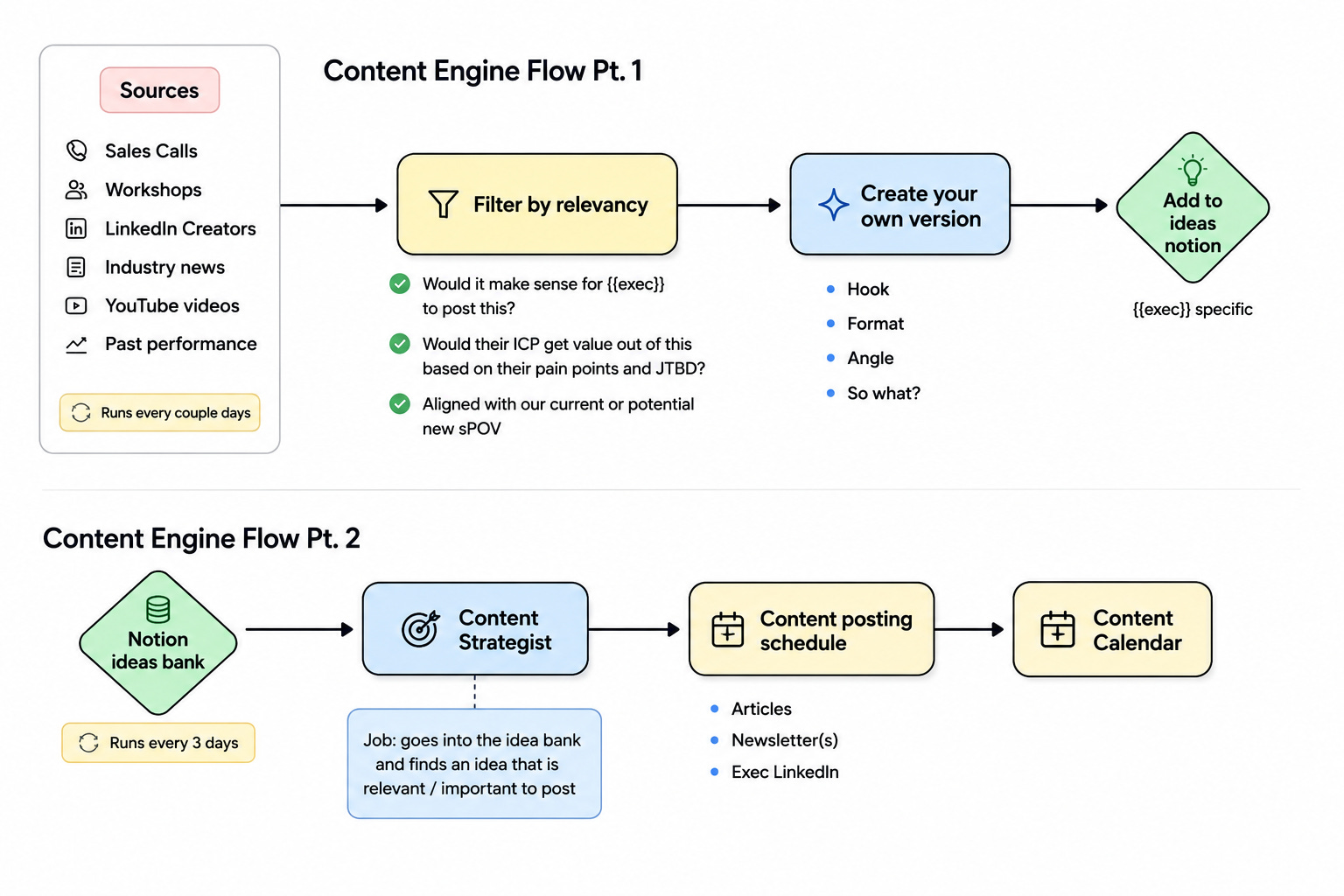
How to build your own self-learning content system
You don’t need a lot to start. The only file Will had before building this was a brand brief in markdown. Company overview, services, ICP broken into personas with psychographic profiles, voice of customer data, jobs to be done framework, proof points, and some of his existing writing/points of view.
He dropped that file it into a local folder, opened Claude Cowork, and used Whisper Flow to ramble about what he wanted the system to do (noticing a pattern here with AI builders using transcription to build with Claude?) Claude asked follow-up questions to clarify the idea and built the skill. The entire process started from a single document and a voice memo.
If you don’t have a brand brief like this, simply start a new Claude chat and say “make me a really detailed brand brief based on my existing context docs/content examples/social media account/website” and it will produce something good enough to start with.
Why Cowork and not Chat
Cowork has scheduled tasks. Chat doesn’t.
Once the skill is set up in Cowork, it runs every Monday morning automatically. In Chat, you’d have to manually trigger the same workflow each time. The building process is identical across Chat, Cowork, and Code. You open a conversation, describe what you want, iterate through Claude’s questions, and it builds the skill. The only difference is that Cowork lets you actually automate it.
We’re trying to move away from all workflows relying on prompting at every step, remember?
How it decides what to write about
The scoring system evaluates each idea on four things:
Whether the topic is fresh (not covered in the last two weeks)
Whether there’s real evidence to support it
Whether it’s relevant to a specific ICP persona
Whether it has a genuinely strong point of view
That last one is where most AI content systems completely fail. Will structures everything around what he calls “spiky points of view,” and this is central to why the output is actually good. Every piece of content needs a real perspective, not a flat observation or a truism that could have come from anyone’s LinkedIn feed.
The brand brief defines what those perspectives are, and the skill enforces them during both the scoring and writing stages. So ideas that don’t carry a clear point of view get filtered out before a single word is written. This week, the system found 12 ideas and narrowed them down to 5.
There’s also a small detail worth stealing: for every post, Claude writes two different opening hooks and picks the one with more tension. You can override the choice, but it automates a step that most people skip entirely, and a great opening line is usually your best chance for a high-performing post.
What tools he used for this workflow
This is now the third episode in a row where Exa has shown up as Claude’s go-to tool, without anyone on the show specifically choosing it. Will told Claude to use Exa and LinkedIn Searcher as his signal sources. When his LinkedIn MCP broke mid-build, Claude quietly switched everything over to Exa, which turned out to handle LinkedIn search just fine on its own. One of the recurring lessons from this show is that Claude is often better at picking its own tools than we are at prescribing them.
Will even canceled two other SaaS subscriptions after rebuilding their full functionality with Exa.
At this point, we REALLY need to bring someone from Exa on the show and learn more about the product, right? We’re literally their biggest fans without even knowing.
Team collaboration challenges with Claude
Bojana raised something during the episode that I think a lot of in-house marketers are running into right now, and it’s worth spending a minute on because it’s a real structural problem, not a skill issue.
She has multiple Claude projects running in parallel: one for reporting, one for research, one for monitoring. Each one works well on its own, but getting the information from one project into another still requires manual copy-pasting and context switching. She tried consolidating everything into a single project, but the output quality dropped immediately.
Will’s fix was architectural. Instead of trying to connect the projects to each other, he suggested adding a dedicated processing step between your sources and your storage layer.
💡Example: When a sales call ends, an automatic step extracts voice of customer data, objections, and proof points, then stores them in a pre-processed, structured format. That way, when a different project needs that data later, it’s already clean. You’re not asking Claude to process raw transcripts AND write good content in the same breath.
Another workaround (read: probably not a long-term solution)is writing a push-to-GitHub-and-Notion step directly into his skills, so that at the end of every session, the output gets shared automatically without him having to think about it.
🔥Hot tip: Do NOT store your files on iCloud or Google Drive
Will spent three days debugging his entire setup because he stored project files on iCloud. The way iCloud works, it creates aliases and offloads files to the cloud when it decides you don’t need them locally. So Claude kept telling him files didn’t exist that he KNEW were there. It eventually corrupted his live website build.
Always keep your Claude project folders on your LOCAL machine, besties.
Resources from this episode
- Exa — search API for signal sourcing, also does LinkedIn search, apparently replaced two of Will’s SaaS tools
- Ordinal — social media scheduling and publishing tool
- Whisper Flow — voice-to-text tool all three of us use to ramble prompts into Claude
- Granola — meeting transcription, great for pulling client insights into content workflows
- Will’s GitHub repo — the full self-learning content system plus resources on LinkedIn profile optimization and hook writing. Download the zip and drag it into your project folder
- Catalyst Content — Will’s agency, find him on LinkedIn if you have questions
What’s coming next
We’re bringing guests monthly now. But that still leaves us with one more episode every month with just your gals! We are TWO GIRLS and one Claude, after all.
Stay tuned for our next live build 🔥🔥🔥